THE ARMSTRONG Economic Code
Volume 3: 2027 Panic Cycle Year Edition.
Martin Armstrong’s Economic Confidence Model holds that capital, confidence and panic turn on a fixed rhythm — one turning point every 8.6 years, or 3,141 days. The third edition brings the focus to the 2027 panic cycle and Armstrong’s latest forecasts, putting the model’s ideas about capital, confidence and turning points in the spotlight.
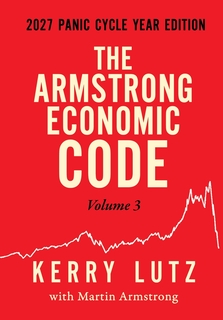
Volume 3: 2027 Panic Cycle Year Edition
A cycle you can set a clock to.
Martin Armstrong's Economic Confidence Model treats capital, confidence, and panic as a single measurable rhythm — a turning point every 8.6 years, derived from pi, repeating since before Rome minted its first denarius.
The book compiled by Kerry Lutz decodes that rhythm for a general reader: where the cycle has already called the turn, and where it points next.
- Rising Confidence — capital concentrates, optimism compounds
- The Turn — the model's signature panic point
- Unwind — confidence breaks, capital flees to safety
- Reset — capital resettles, the next cycle begins
Five things the book asks you to never forget.
Compiled and expanded by Kerry Lutz from decades of Armstrong's own forecasting record, connecting history, markets, and the rhythm of human behavior.
The 8.6-year cycle marks the turns.
The Economic Confidence Model's core rhythm has, the authors argue, lined up with major turning points in global capital for more than forty years.
Capital migrates on a schedule.
Money doesn't vanish in a crisis — it moves. The book traces how capital flows between nations and asset classes reveal where wealth and power are headed next.
Governments fall on cue, not by accident.
Confidence in institutions rises and breaks in the same predictable rhythm as markets do — and the book argues that's rarely a coincidence.
The post-2020 chart keeps writing itself.
New commentary and charts extend Armstrong's earlier work into the pandemic era and beyond, updating the model against what's already happened.
A forecast is only useful if you act on it.
The closing chapters translate the model into practical terms — how a reader might interpret the next turn to protect, and grow, what they hold.
“What if the economy wasn't chaotic at all—but followed a hidden code?”— The Armstrong Economic Code
A new edition. A focus on 2027.
The Armstrong Economic Code: Volume 3, 2027 Panic Cycle Year Edition brings a timely focus to the series: the 2027 panic cycle. Explore Armstrong’s latest forecasts in the context of the approaching 2027 panic cycle. For readers following his work, it is a reason to return to the questions at the heart of the code — how confidence shifts, where capital moves, and why turning points matter.
New to the series? Start with the Economic Confidence Model and its 8.6-year rhythm, then explore the new volume. Paperback and hardcover are available now at a discount compared with Amazon.
The third edition is here.
Order the 2027 Panic Cycle Year Edition in paperback or hardcover at a discount compared with Amazon, or get the Kindle edition on Amazon.
Start with the model, not the marketing.
Three plain-English explainers on the framework the book is built from — free to read, no email required.
The Economic Confidence Model
What the ECM actually claims, how Armstrong built it, and the nested cycles that sit above and below the 8.6-year wave.
Read the explainer → ExplainerThe 8.6-Year Cycle & Pi
Why 3,141 days, where the number came from, and how a cycle you can count on a calendar is supposed to work.
Read the explainer → ProfileWho Is Martin Armstrong?
Four decades of forecasting, Princeton Economics, eleven years in prison, and the record the book asks you to weigh.
Read the profile →What people ask about the Economic Confidence Model.
Short answers on the model, the man, and the book — including the objections.
01 What is the Economic Confidence Model?
The Economic Confidence Model, or ECM, is Martin Armstrong’s cyclical framework for reading capital flows and market confidence. It holds that concentrations of confidence and panic recur on a measurable rhythm — a turning point roughly every 8.6 years — and that those turns can be dated on a calendar in advance. The Armstrong Economic Code is Kerry Lutz’s plain-English guide to how the model is built and how Armstrong has applied it. Read the full explainer →
02 Why is the cycle 8.6 years long?
Armstrong has written that he arrived at 8.6 years while testing whether the October 1987 crash landed on a precise interval rather than by chance. An 8.6-year span works out to roughly 3,141 days — pi multiplied by a thousand — which he took as a sign the rhythm was structural.
The book walks through that derivation and the nested cycles built on top of it: a 2.15-year quarter cycle, and a 51.6-year wave made of six 8.6-year cycles. More on the 8.6-year cycle →
03 What is the pi cycle?
“Pi cycle” is shorthand for the same 8.6-year interval, named for the 3,141-day count at its centre. Readers meet the phrase in Armstrong’s own writing and across cycle-trading commentary; it refers to the ECM’s base wavelength rather than to a separate model.
04 Who is Martin Armstrong?
Martin A. Armstrong is the analyst who created the Economic Confidence Model and founded Princeton Economics International. He began publishing commodity forecasts in the 1970s and has applied his cycle work to markets and geopolitics for more than four decades. He was convicted of investment fraud in the United States and served eleven years before his release in 2011, and now writes at Armstrong Economics. He contributes the foreword to this book. Read the full profile →
05 What are the 5 Truths investors must never forget?
The book organises Armstrong’s work into five ideas: the 8.6-year cycle marks the turns; capital migrates on a schedule rather than vanishing in a crisis; governments and institutions fail on cue rather than at random; the post-2020 record extends the same chart; and a forecast is only useful if you act on it. The book explores each of these themes. See the five →
06 Is the Economic Confidence Model accurate?
Armstrong points to a list of turning points he says the model called in advance, and the book lays that record out for readers to weigh.
It is worth being plain that mainstream economics does not recognise a pi-derived business cycle, and critics argue the record owes a good deal to fitting the model to events after the fact. The Armstrong Economic Code presents the model and its history so you can judge it yourself. Nothing on this site is investment advice.
07 When is the next Economic Confidence Model turning point?
The book explains how ECM turning points are located rather than publishing a live forecast, so readers can date the turns themselves from the model’s own arithmetic. For Armstrong’s current published positions, see his own writing at Armstrong Economics.
08 Do I need an economics background to read the book?
No. Kerry Lutz compiled the book for a general reader after more than a decade of interviewing Armstrong and other forecasters on the Financial Survival Network. Charts are explained as they appear, and the arithmetic stays at the level of a calendar and a percentage.
09 What is the Dollar Time Machine?
It is the free calculator at the top of this page. Enter an amount and two years and it shows what keeping pace would have cost, measured against everyday prices, housing, gold, silver, the Dow Jones, the S&P 500 or bitcoin, alongside the US national debt counting live. It is the quickest way to see the loss of purchasing power the book is about.
09 Where can I buy The Armstrong Economic Code?
The third edition, Volume 3: 2027 Panic Cycle Year Edition, is available in paperback and hardcover at a discount compared with Amazon. The Kindle edition is available on Amazon. Choose your format in the editions table on this page.